
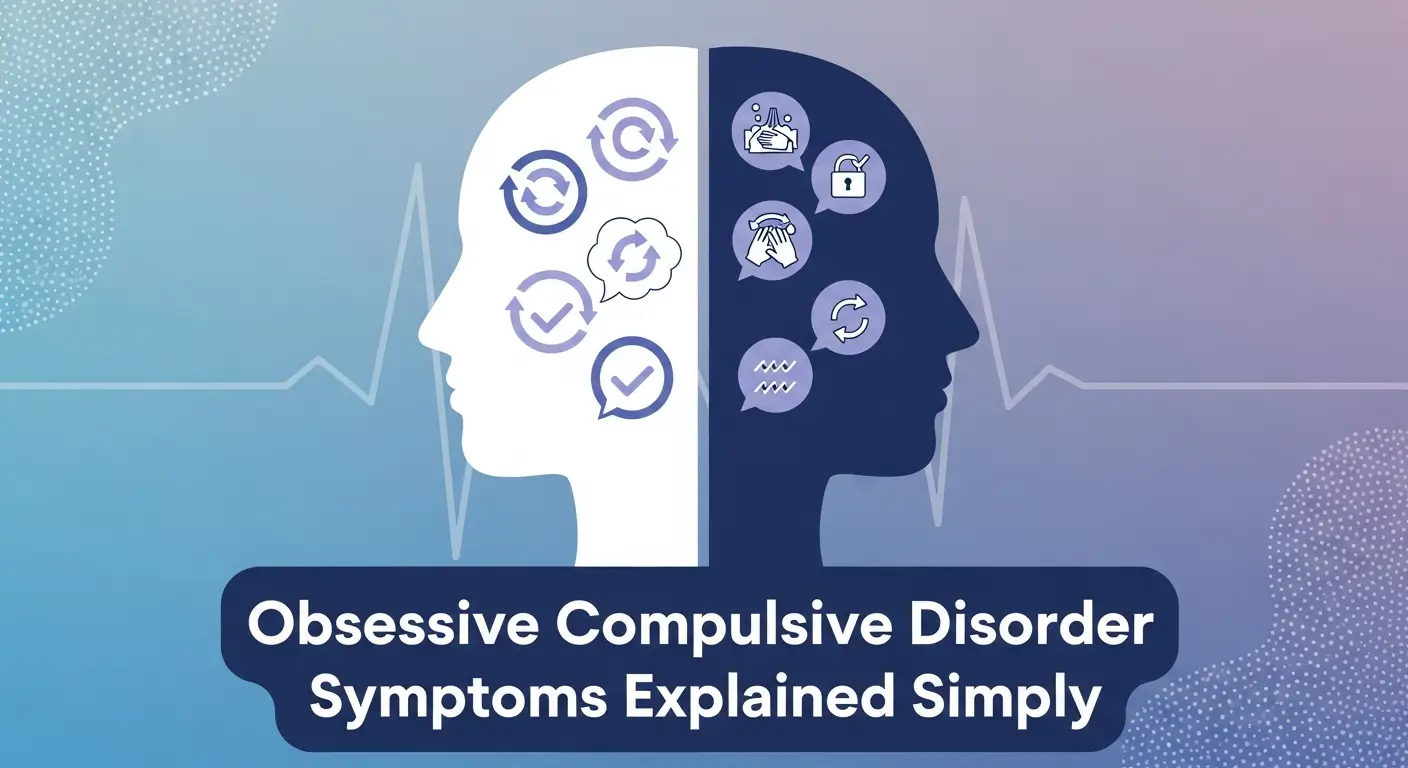
Obsessive Compulsive Disorder Symptoms Explained Simply
OCD, or obsessive compulsive disorder, is a mental health condition that affects how a person thinks, feels, and behaves. It has two main parts:
- Obsessions: unwanted, upsetting thoughts, images, or urges that keep coming back.
- Compulsions: repeated actions or mental rituals a person feels driven to do to reduce anxiety from those thoughts.
People with OCD usually know their thoughts and behaviors do not fully make sense. Still, the anxiety feels so strong that they feel they “have to” do the compulsions to feel safe or calm — even if the relief only lasts a short time.
Understanding obsessive compulsive disorder symptoms makes it easier to recognize when you or someone you love might need help.
Table of Contents
What Is Obsessive Compulsive Disorder (OCD)?
In simple terms:
- OCD is a mental health condition, not a personality trait or a “quirk.”
- It causes obsessions (unwanted thoughts) and compulsions (repeated behaviors or mental acts).
- These symptoms are not just habits. They cause distress and interfere with daily life.
- Compulsions are usually done to reduce fear or discomfort, but the relief is temporary, and the cycle repeats.
OCD is fairly common, and it can affect children, teens, and adults. It is not a sign of weakness, and it is not something a person can just “snap out of.”
What Are Obsessions?
Obsessions are unwanted thoughts, images, or urges that keep popping into a person’s mind, even when they do not want them. These thoughts can feel disturbing, scary, or very uncomfortable.
Important:
- Obsessions are not the same as regular worries.
- The person usually knows the thoughts are excessive or unrealistic, but they still feel very real and upsetting.
- Trying to ignore or push them away often makes the anxiety stronger.
Common types of obsessions include:
- Fear of germs or contamination
- Worrying about touching doorknobs, money, public surfaces, or other people.
- Fear of getting sick or making others sick.
- Worry about harm or danger
- Fear of causing a fire, accident, or injury, even by mistake.
- Fear of harming others, like “What if I accidentally hurt someone?”
- Need for things to be “just right”
- Feeling very uncomfortable if objects are not lined up, centered, or arranged in a certain way.
- Intrusive thoughts (violent, sexual, or disturbing)
- Unwanted images or ideas that go against the person’s values, such as hurting someone or doing something inappropriate.
- These thoughts do not mean the person wants to do these things — they are distressing exactly because they go against who they are.
- Fear of making mistakes
- Constant doubt about whether something was done correctly: “Did I lock the door? Did I send the message right? Did I offend someone?”
Obsessions create anxiety, guilt, or shame. To reduce these feelings, people with OCD often perform compulsions.
What Are Compulsions?
Compulsions are actions or mental rituals a person feels driven to do in response to an obsession. The goal is usually to:
- Reduce anxiety or fear
- Prevent something bad from happening (even if it is unlikely)
Compulsions can be visible behaviors or silent mental steps. They may bring short-term comfort, but they keep the OCD cycle going.
Common compulsions include:
- Excessive hand washing or cleaning
- Washing hands again and again, sometimes until the skin is red or sore.
- Cleaning objects or spaces repeatedly to feel safe.
- Repeated checking
- Checking doors, locks, stoves, windows, or appliances many times.
- Re-reading messages or assignments over and over to be “sure” they are correct.
- Counting or repeating words
- Counting to a certain number, repeating phrases, or praying in a specific way.
- Believing that if this is not done “right,” something bad will happen.
- Ordering or arranging items
- Lining things up perfectly, adjusting objects until they feel “just right.”
- Feeling very upset if someone moves or changes the arrangement.
- Seeking constant reassurance
- Asking the same questions repeatedly: “Are you sure it’s okay? Did I do something wrong? Is everything safe?”
- Needing others to confirm things are fine again and again.
Compulsions can take a lot of time. For some people, these actions can add up to hours each day, making school, work, and relationships much harder.
Common OCD Symptom Patterns
Not everyone with OCD has the same symptoms, but certain patterns are common. A person may have one main pattern or a mix of several.
Contamination OCD
- Strong fear of germs, dirt, or illness.
- Avoiding public spaces, handshakes, or shared items.
- Excessive cleaning, hand washing, or use of sanitizers.
This is not the same as normal cleanliness. The fear and cleaning feel extreme and hard to stop.
Checking OCD
- Repeatedly checking locks, ovens, lights, or alarms.
- Going back home many times to make sure things are off or closed.
- Fear that if they do not check enough, something terrible will happen (like a fire or break-in).
Checking can make it very hard to leave the house or move on to the next task.
Symmetry and Order OCD
- Strong need for exactness, balance, or symmetry.
- Rearranging items until they feel “perfect” or “even.”
- Counting, tapping, or moving in patterns that feel “right.”
This pattern is not about simply liking neatness; it involves intense discomfort if the pattern is broken.
Intrusive Thought OCD
- Disturbing thoughts about violence, sex, religion, or morality.
- Fear of hurting someone, even if the person has never been violent.
- Fear of being a “bad person” because of these thoughts.
People with this type often feel deep shame. But these thoughts are unwanted and do not mean the person wants to act on them.
How OCD Symptoms Affect Daily Life
OCD is more than a set of quirks. It can deeply affect how someone lives each day.
Possible impacts:
- Trouble focusing: Obsessions interrupt concentration at work, school, or in conversations.
- Delays in daily routines: Simple tasks like leaving the house or going to bed can take a very long time.
- Stress and exhaustion: Constant anxiety and rituals are tiring, both mentally and physically.
- Relationship problems: Loved ones may not understand OCD or may feel frustrated by repeated questions or rituals.
- Work or school difficulties: Being late, distracted, or unable to finish tasks can create problems with performance and attendance.
Many people with OCD feel embarrassed and keep their symptoms secret, which can make them feel even more alone.
What Causes OCD?
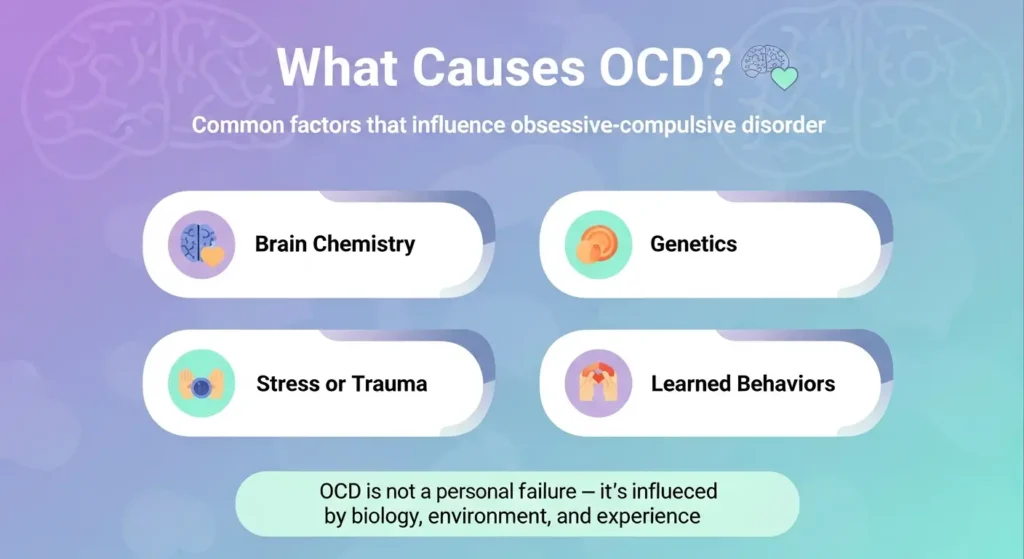
Experts do not know one single cause of OCD, but several factors seem to play a role.
Possible causes include:
- Brain chemistry: Differences in certain brain chemicals (like serotonin) and brain circuits that control fear and habits.
- Genetics: OCD can run in families. Having a close relative with OCD or related conditions may increase risk.
- Stress or trauma: Stressful life events or trauma may trigger symptoms in someone who is already at risk.
- Learned behaviors: Sometimes, people learn from family or environment that certain fears or rituals are “necessary” and these patterns become strong over time.
OCD is not anyone’s fault. It is not caused by being “too careful” or “too neat” as a personality. It is a real medical condition that can be treated.
OCD vs Normal Habits
Many people like things clean or organized, or double-check that doors are locked. That does not mean they have OCD. The difference lies in how intense, frequent, and distressing the behavior and thoughts are.
Here is a simple comparison:
| Normal Habit | OCD Symptom |
|---|---|
| Checking the door once before bed | Checking the door many times, feeling unable to stop, fearing disaster if it is not checked “enough” |
| Liking your desk tidy | Feeling extreme distress if items are not perfectly aligned; unable to focus until it is “just right” |
| Worrying sometimes about getting sick | Constant intrusive thoughts about germs, avoiding many places, washing hands dozens of times a day |
| Saying a quick prayer or positive phrase | Repeating a phrase a specific number of times to stop something bad from happening, feeling guilty or anxious if it is not exact |
With OCD, the thoughts and actions are intense, time-consuming, and interfere with life.
When to Seek Help
It may be time to seek professional help if:
- Obsessions and compulsions take more than an hour per day.
- You feel unable to control your thoughts or rituals.
- Symptoms cause serious stress, fear, guilt, or shame.
- Daily life (school, work, relationships, hobbies) is affected.
- You avoid situations just to prevent anxiety or compulsions.
Talking to a doctor, psychologist, or psychiatrist is a strong and brave step. They can help determine if the symptoms are OCD and suggest treatment options.
How OCD Is Treated
OCD is treatable. Many people see big improvements with the right help. Treatment often includes therapy, medication, or both.
Therapy
The main type of therapy for OCD is:
- Cognitive Behavioral Therapy (CBT):
- Helps you understand the connection between thoughts, feelings, and behaviors.
- Teaches new ways to respond to obsessions without doing compulsions.
A special kind of CBT is:
- Exposure and Response Prevention (ERP):
- You slowly and safely face situations that trigger your obsessions (exposure).
- You practice not doing the compulsive behavior (response prevention).
- Over time, your brain learns that the fear decreases even without the ritual.
ERP is considered one of the most effective treatments for obsessive compulsive disorder symptoms.
Medication
Doctors may prescribe medication to help reduce OCD symptoms, often alongside therapy.
- The most common medicines are SSRIs (selective serotonin reuptake inhibitors), a type of antidepressant that also helps with OCD.
- Medication can make obsessions and compulsions feel less intense, so therapy is easier to do.
A doctor or psychiatrist will explain options, doses, and possible side effects.
Self-Help Support
Self-care does not replace professional treatment, but it can support recovery:
- Stress management: Relaxation, deep breathing, gentle exercise, and hobbies.
- Routine: Regular sleep, meals, and activity help keep your mind and body balanced.
- Support groups: Talking to others with OCD can reduce shame and give practical tips.
- Education: Learning about OCD helps you understand that you are not alone and not at fault.
Conclusion
Obsessive compulsive disorder is more than just liking things neat or double-checking the stove. It is a real mental health condition with powerful thoughts and behaviors that can take over daily life. But it is also treatable, and many people learn to manage their symptoms and regain control.
By understanding obsessive compulsive disorder symptoms — obsessions, compulsions, and how they affect daily living — you are already taking an important first step. If you or someone you care about is struggling with these patterns, reaching out for help is a sign of strength, not weakness.
Understanding OCD is the first step toward healing, support, and a more peaceful mind.
FAQ: Obsessive Compulsive Disorder Symptoms Explained
What are the first signs of obsessive compulsive disorder?
Early signs may include repeated, unwanted thoughts that are hard to ignore; feeling driven to repeat behaviors such as washing, checking, or counting; strong anxiety when trying to resist these behaviors; and a noticeable increase in the time needed to complete simple tasks.
Can OCD symptoms come and go?
Yes. Symptoms can become better or worse at different times, especially during stress or major life changes. Some people have periods when OCD feels milder and other times when it feels much stronger.
Is OCD the same as being a perfectionist?
No. Perfectionism is about wanting things done well or fearing mistakes. OCD involves intense, unwanted thoughts and rituals that cause distress and interfere with daily life.
Can children have OCD?
Yes. OCD can begin in childhood or adolescence. Children may show it through repeated questions, bedtime rituals, fear of germs, or a strong need for things to be arranged in specific ways.
How is OCD diagnosed?
A mental health professional asks about thoughts, behaviors, and emotions, looks at how much time symptoms take and how much they affect daily life, and rules out other conditions. There is no blood test or brain scan for OCD.
Can OCD go away on its own?
OCD rarely disappears completely without help. Symptoms may change over time, but without treatment they often stay or return. Therapy and, if needed, medication can greatly reduce symptoms and help people live calmer lives.
Disclaimer
The information on HealthHintz is provided for educational and informational purposes only and should not be considered medical advice. Always consult a qualified healthcare professional before making any medical or health-related decisions, starting a new treatment, or changing your existing health plan.