
Chemical Pregnancy Symptoms: What to Expect
You saw it. A faint positive line on a pregnancy test, and in that single moment, a world of hope started to grow. You imagined the future, felt a flutter of excitement, and began to dream. But then, just a few days later, your period arrived, maybe heavier or more painful than usual. The line on the test faded, and confusion and heartbreak set in.
If this experience feels painfully familiar, you may have had what’s known as a chemical pregnancy. It’s a term for a very early miscarriage that happens shortly after a fertilized egg implants in the uterus. Please know this: you are not alone, this is incredibly common, and it is never your fault. This guide will gently walk you through what a chemical pregnancy is, the common chemical pregnancy symptoms, and how you can care for yourself, both physically and emotionally.
Table of Contents
What Is a Chemical Pregnancy?
A chemical pregnancy is a very early pregnancy loss that occurs within the first five weeks of gestation, usually before an embryo can even be seen on an ultrasound. It’s called “chemical” because the pregnancy is only detectable through chemical means—specifically, the pregnancy hormone human chorionic gonadotropin (hCG) in your blood or urine.
It happens when a fertilized egg implants in the uterus, begins to develop, and produces enough hCG to give you a positive pregnancy test. However, for various reasons, the embryo stops developing very soon after. This is often due to an implantation failure or an issue with the embryo itself. Because it happens so early, many women experience a chemical pregnancy without ever realizing they were pregnant, mistaking the bleeding for a slightly late or heavy period.
Key Facts About Chemical Pregnancy Symptoms
| Feature | Description |
|---|---|
| When it happens | Usually within one to two weeks after conception, before the 5th week of pregnancy. |
| Detection | A positive pregnancy test then period arrives soon after. The test line is often faint. |
| Common cause | Most often caused by chromosomal problems in the embryo that are not compatible with life. |
| Emotional impact | Though the loss is early, the emotional pain is real and deeply felt. |
Common Symptoms of a Chemical Pregnancy
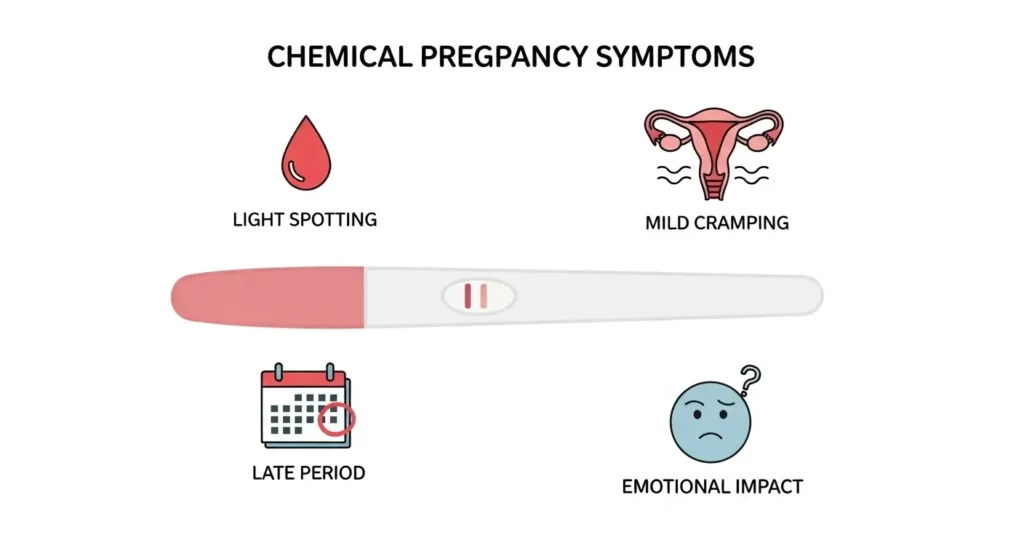
The chemical pregnancy signs can be subtle and are often mistaken for regular premenstrual or menstrual symptoms. The most telling sign is the timing of a positive test followed closely by bleeding.
Early Physical Signs
- A faint positive pregnancy test: You might get a faint positive pregnancy test that either stays faint or gets lighter over a few days before turning negative.
- Period-like bleeding: You experience bleeding that starts around the time your period was due, or a few days to a week late.
- A period that’s heavier than usual: The bleeding can be heavier and contain more clots than your typical period.
- Mild to moderate cramping: You may experience abdominal cramps that feel similar to or slightly more intense than your usual period cramps.
- Low hCG levels: If you have a blood test, your hCG levels will be low and will not double every 48-72 hours as they would in a healthy pregnancy.
- No pregnancy signs on an ultrasound: It happens too early for a gestational sac to be visible on an ultrasound.
How It Differs From a Normal Period
It can be hard to tell the difference, but here are a few things that might stand out.
| Symptom | Normal Period | Chemical Pregnancy |
|---|---|---|
| Timing | Arrives around the same time each cycle. | Often a few days to a week late. |
| Flow | Your typical flow (light, medium, or heavy). | Often heavier, with more clots than your normal period. |
| Cramping | Your usual level of cramping. | Cramps may be stronger or more painful than usual. |
| Pregnancy Test | Negative. | Positive at first, then quickly turns negative. |
Why Chemical Pregnancies Happen
The most important thing to understand about chemical pregnancy causes is that they are almost never related to anything you did or didn’t do. The vast majority of these early losses happen because of circumstances beyond anyone’s control.
The most common reason is a chromosomal abnormality in the fertilized egg. This means the egg or sperm had the wrong number of chromosomes, and the resulting embryo could not develop properly. This is a random event and is the body’s natural way of stopping a pregnancy that would not have been viable.
Other possible contributing factors include:
- Hormone imbalances (such as low progesterone).
- A thin or unreceptive uterine lining.
- Problems with the quality of the egg or sperm.
- An implantation failure where the embryo doesn’t attach securely to the uterine wall.
- Underlying thyroid or autoimmune issues.
It’s important to hear this again: nothing you did caused this. It is not your fault. It is your body’s protective mechanism recognizing that something wasn’t developing as it should.
Emotional Impact and Recovery
Even though a chemical pregnancy happens very early, the loss is real. It is a loss of the hopes, plans, and excitement you felt in that moment you saw a positive test. Your feelings of grief, sadness, anger, or confusion are completely valid. Don’t let anyone, including yourself, minimize your pain.
Emotional recovery after miscarriage, no matter how early, takes time. Be gentle with yourself and allow yourself to heal.
- Talk to someone you trust. Share your feelings with your partner, a close friend, or a family member. Saying your feelings out loud can make a huge difference.
- Give yourself time and space to grieve. There is no timeline for grief. Allow yourself to feel sad and process the loss in your own way.
- Consider journaling. Writing down your thoughts and feelings can be a powerful way to process them without judgment.
- Practice self-care. Your body and mind have been through a lot. Prioritize rest, eat nourishing food, and do gentle activities that bring you comfort, like taking a warm bath or going for a walk in nature.
What to Do After a Chemical Pregnancy
After confirming an early pregnancy loss, your focus should be on gentle recovery, both physically and emotionally.
Physical Care
Physically, your body will likely recover quickly, as if you’ve just had a slightly heavier period.
- The bleeding may last for a few days up to a week. Use pads instead of tampons to monitor the flow and avoid infection.
- You can manage cramping with over-the-counter pain relievers like ibuprofen, if needed.
- Most women do not require any medical intervention, as the body handles the process naturally.
Trying to Conceive Again
The experience of a chemical pregnancy can make the thought of trying again feel scary, but there is reason for hope. A chemical pregnancy is a sign that you can get pregnant—an egg was fertilized and implantation began. Many women go on to have healthy, successful pregnancies soon after.
Doctors often suggest waiting until you’ve had at least one normal menstrual cycle before trying to conceive again. This isn’t usually for a medical reason but to make it easier to date the next pregnancy accurately. Most importantly, wait until you feel emotionally ready.
If you experience two or more chemical pregnancies in a row, it’s a good idea to speak with your doctor. They may want to run some tests to check for any underlying issues.
When to Call a Doctor
While a chemical pregnancy usually resolves on its own without complications, you should contact your doctor if you experience any of the following:
- Heavy bleeding: Soaking through more than one pad per hour for two hours in a row.
- Severe pain or cramping: Pain that is not relieved by over-the-counter medication.
- Signs of infection: A high fever, chills, or foul-smelling vaginal discharge.
- Dizziness or fainting: These could be signs of excessive blood loss.
FAQs About Chemical Pregnancy
How soon does a chemical pregnancy happen?
A chemical pregnancy occurs very early, typically within the first 5 weeks of pregnancy (less than 3 weeks after ovulation). It happens after implantation but before an embryo can be seen on an ultrasound.
Can stress cause a chemical pregnancy?
No, everyday stress does not cause a chemical pregnancy. The vast majority of chemical pregnancy causes are related to chromosomal issues in the embryo that are completely out of your control.
Do I need treatment for a chemical pregnancy?
In most cases, no medical treatment is needed. Your body will pass the tissue naturally, much like a period. However, it’s always a good idea to let your doctor know what happened so they can confirm it was a chemical pregnancy and rule out other issues.
Can I get pregnant again after a chemical pregnancy?
Yes, absolutely. Having one chemical pregnancy does not mean you will have another. Many women go on to have healthy pregnancies. It can even be a reassuring sign that your body is capable of conception.
How can I cope with the emotional side of a chemical pregnancy?
Allow yourself to grieve and acknowledge that your loss is real. Lean on your support system, practice self-compassion, and consider talking to a therapist who specializes in pregnancy loss. Remember, your feelings are valid.
Conclusion
A chemical pregnancy may end almost as soon as it begins, but the emotional experience is real, powerful, and deserving of compassion. It is a quiet loss that can carry a heavy weight. With time, care, and a true understanding of what happened, recovery—both physical and emotional—is possible.
Be kind to yourself as you navigate this journey. Your body’s ability to conceive and its strength through this experience are proof of your incredible resilience.
Disclaimer
The information on HealthHintz is provided for educational and informational purposes only and should not be considered medical advice. Always consult a qualified healthcare professional before making any medical or health-related decisions, starting a new treatment, or changing your existing health plan.